
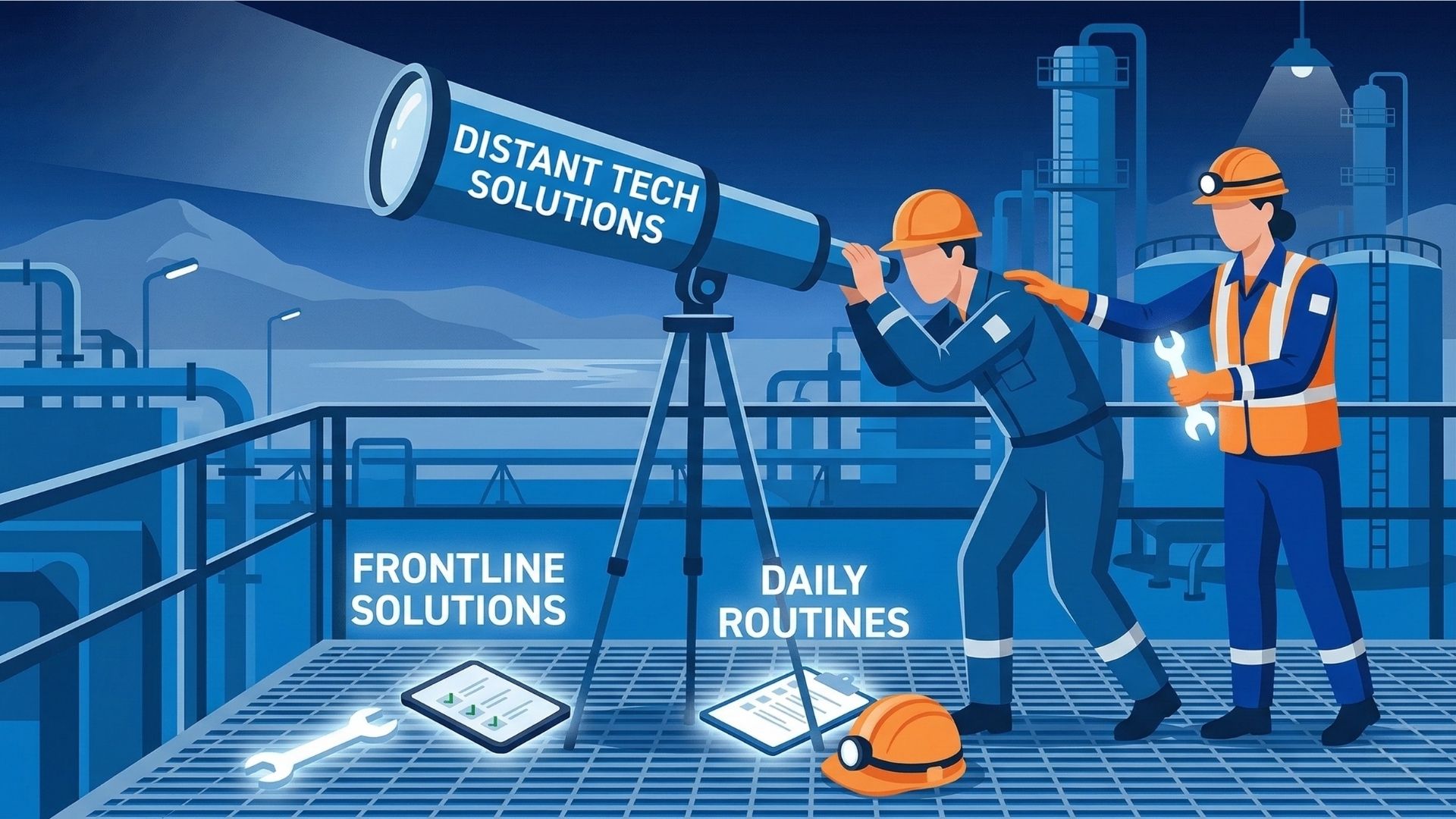
Proximity Bias: Overlooking the Solutions Right in Front of You
Research based on Gallup’s work shows that actively disengaged employees can cost an organization up to 34% of their annual salary through lost productivity, absenteeism, and quality issues.
For a team of 100 industrial workers earning an average of $60,000 per year, that can mean more than $2 million in lost value every year simply because tools and processes were not built for how people actually work.
How Disengagement Shows up in Operations
Higher engagement is linked to better productivity, quality, and profitability, while disengaged teams experience more defects, rework, and unplanned downtime. In high risk environments, the consequences are even more serious. A large Gallup meta analysis of 1.8 million employees across 82,000 businesses found that highly engaged teams had about 70% fewer safety incidents than poorly engaged ones. When workers are frustrated with clunky systems, they are less likely to:
- Report hazards and near misses
- Log issues in digital tools
- Follow digital procedures end to end
The organization pays for that in risk, downtime, and poor decisions.
The Boardroom to Frontline Gap
This disconnect between the boardroom and the job site often creates three major problems:

1. Inaccurate Data:
Leaders describe a “usability gap”, where powerful back end systems, such as ERP or EHS platforms, are too rigid or complex for everyday frontline use. Workers fall back on paper forms, informal conversations, or offline spreadsheets, which erodes data quality and makes it harder to trust what shows up in dashboards.

2. Compliance & Safety Risk:
When systems are difficult to use, reporting becomes inconsistent. Studies that connect engagement to approximately 64-70% fewer safety incidents show how much risk is involved when workers disengage from formal systems and processes – raising the chance of regulatory issues and reputational damage.

3. Wasted Budgets:
Even strong, enterprise grade solutions fail if frontline teams do not adopt them. Analyses of disengagement show that the cost of under-used systems and lost productivity can represent more than one third of salary spent for disengaged workers, turning a strategic investment into an ongoing liability.
Look Closer to the Work, Not Farther Away
Overcoming proximity bias in technology decisions starts with looking closer to the work itself. Instead of defaulting to distant, unfamiliar technologies, leaders can first look at solutions that are close to the work:
- Built for similar working conditions and constraints
- Shaped by people who understand the environment
- Tested in operations that look like their own
Studies of frontline technology use show that usability, simplicity, and alignment with daily routines are key drivers of long term adoption and better outcomes. These qualities are far more likely when solutions are developed near the point of need and informed by nearby frontline experience.
What Happens When Technology Fits the Reality
When frontline staff use straightforward, intuitive systems that reflect how they actually work, several things improve at once:
- Engagement and participation
- Data quality and timeliness
- Leaders’ ability to make fast, confident decisions
Research on engagement shows that highly engaged teams can achieve significant improvements in productivity and quality, along with large reductions in safety incidents. Performance and safety both improve when technology is chosen for its fit with daily reality and its closeness to the problem context, not just for its global reputation.
Challenge the “Somewhere Else” Assumption
It may be time to question the assumption that the best solutions are always found somewhere else.
By prioritizing technologies that are closer to your operations, whether in geography, industry focus, or working conditions, organizations can:
- Reduce operational blind spots
- Improve decision-making and execution
- Increase frontline participation
- Strengthen safety and compliance performance
Frontline-centric technology with intuitive interfaces, mobile access, and workflows modeled on real work has been shown to improve participation, consistency, and the quality of data captured at the frontline.
Rethinking Proximity Bias in Technology Decisions
Organizations often search globally for answers to operational challenges. But the most effective solutions may already exist closer than they think.
By challenging proximity bias and evaluating tools based on how well they fit your operational context, organizations can achieve:
- Better efficiency
- Stronger engagement
- Safer outcomes
The key is to focus less on where a solution comes from and more on how well it supports the work happening every day.
Look closely at technologies operating in environments similar to yours, especially those built with real frontline experience. When tools align with the realities of your operation, adoption improves, decisions become clearer, and progress becomes measurable across the entire organization.
The best solutions are often closer than you think.
Discover how Sofvie helps organizations bridge the gap between leadership and the frontline by turning everyday work into clear, reliable insight.